What Is the Best Bet in Roulette?

Roulette captivates gamblers worldwide with its spinning wheel, bouncing ball, and the tantalizing promise of big payouts. But amidst the excitement, one question dominates serious players’ minds: what is the best bet in roulette? The answer isn’t as straightforward as picking a single number or color — it depends on your goals, risk tolerance, and understanding of roulette odds. Whether you’re chasing the highest chance of winning roulette spins or willing to accept lower probabilities for bigger rewards, different bets serve different purposes. From even money wagers that hit frequently to straight-up bet payouts offering 35:1 returns, each option on the roulette payout table carries distinct mathematical properties. This guide examines roulette odds comprehensively, exploring inside and outside wagers, comparing European against American roulette double zero disadvantages, and revealing which statistical bet in roulette offers the best value for your money when you play roulette online or at land-based casinos.
Is There Really a Best Bet in Roulette?
The concept of a “best bet” in roulette requires nuance. Unlike games with optimal strategies that reduce the casino edge comparison to near-zero, roulette’s wheel layout structure ensures the house always maintains an advantage. Every bet — whether a red/black wager or an exotic roulette snake bet — carries negative expected value in roulette through the roulette house edge percentage. Understanding the mathematics behind all bets on roulette helps players make informed decisions about their wagering strategies.
That said, certain bets offer better mathematical value. The “best” bet depends on your objective. Are you seeking the highest probability of winning, maximizing entertainment through bankroll management in roulette, or chasing big payouts? Your answer determines which roulette bet suits you best.
For players prioritizing frequent wins, even money wagers like red/black, odd/even, and high/low provide the highest chance of winning roulette spins — just under 50% on European wheels. These low risk casino bets sustain your bankroll. Conversely, straight-up bets offer 35:1 payouts but hit less than 3% of the time, representing high volatility gambling options.
No roulette bet changes the fundamental house edge. European wheels maintain 2.7% casino advantage, while American roulette double zero wheels push it to 5.26%. The statistically “best” bet minimizes the house edge — making European roulette with even money wagers optimal.
Understanding Roulette Odds and House Edge

Grasping odds playing roulette requires understanding three interconnected concepts: probability, payout ratios, and house edge. The roulette probability chart reveals that each number on a European wheel (0-36) theoretically has a 1/37 chance of hitting per spin, while American wheels with both 0 and 00 create 1/38 probabilities.
The roulette payout table compensates winners at rates slightly below true odds, creating the roulette house edge percentage. For example, a straight-up bet pays 35:1, but true odds on a European wheel are 36:1. That one-unit discrepancy between true odds and actual payout generates the casino’s profit margin. On European wheels, this creates a 2.7% house edge. The American roulette double zero exacerbates this— most bets face 5.26% house edge because payouts remain identical despite worse odds.
Understanding expected value in roulette clarifies why the house edge persists across all standard bets. A $10 straight-up bet on European roulette yields an expected value of -$0.27 per spin. Every $10 wagered returns $9.73 on average over infinite spins. Even money bets face identical math. Whether you bet inside or outside, single numbers or groups, European roulette’s house edge remains constant at 2.7%.
American wheels worsen these numbers. The double zero increases losing outcomes without improving payouts, pushing expected value further negative. A $10 straight-up bet on American roulette loses approximately $0.53 per spin on average — nearly double European wheels’ theoretical loss rate. This mathematical disadvantage makes American roulette objectively worse for players seeking best odds for roulette regardless of betting strategy.
Inside vs Outside Bets – Which Is Better?
The debate between inside and outside wagers represents roulette’s fundamental strategic choice. Inside bets cover specific numbers or small groups directly on the numbered grid, offering higher payouts but lower win probabilities. Outside bets cover larger groups like red/black or dozens, delivering frequent wins with smaller returns. Neither category inherently provides roulette best odds in terms of house edge — both face identical 2.7% on European wheels — but they create vastly different playing experiences.
Outside Bets: Consistency and Bankroll Preservation
Even money wagers (red/black, odd/even, high/low) hit approximately 48.6% of spins on European wheels, making them the highest chance of winning roulette offers. You’ll win nearly half your bets, creating a steady rhythm that extends playing time and minimizes dramatic swings. These represent the ultimate low risk casino bets for conservative players prioritizing entertainment over profit. Column and dozen bets improve payouts slightly (2:1) while still hitting 32.4% of the time.
Inside Bets: Volatility and Big Win Potential
Straight-up bets on single numbers pay 35:1 but hit just 2.7% of spins. Split bets pay 17:1 with 5.4% hit rates. Street bets offer 11:1 payouts at 8.1% frequency. Corner bets cover four numbers for 8:1 returns hitting 10.8% of spins. These represent high volatility gambling options — you’ll lose far more often, but wins deliver substantially larger returns.
For bankroll management in roulette, outside bets excel. Conservative players preferring simple roulette strategy that works reliably should stick with even-money outside bets. Aggressive players seeking excitement can explore inside bets, understanding they’ll lose more frequently but enjoy larger payouts when luck strikes.
European vs American Roulette – Which Offers Better Value?
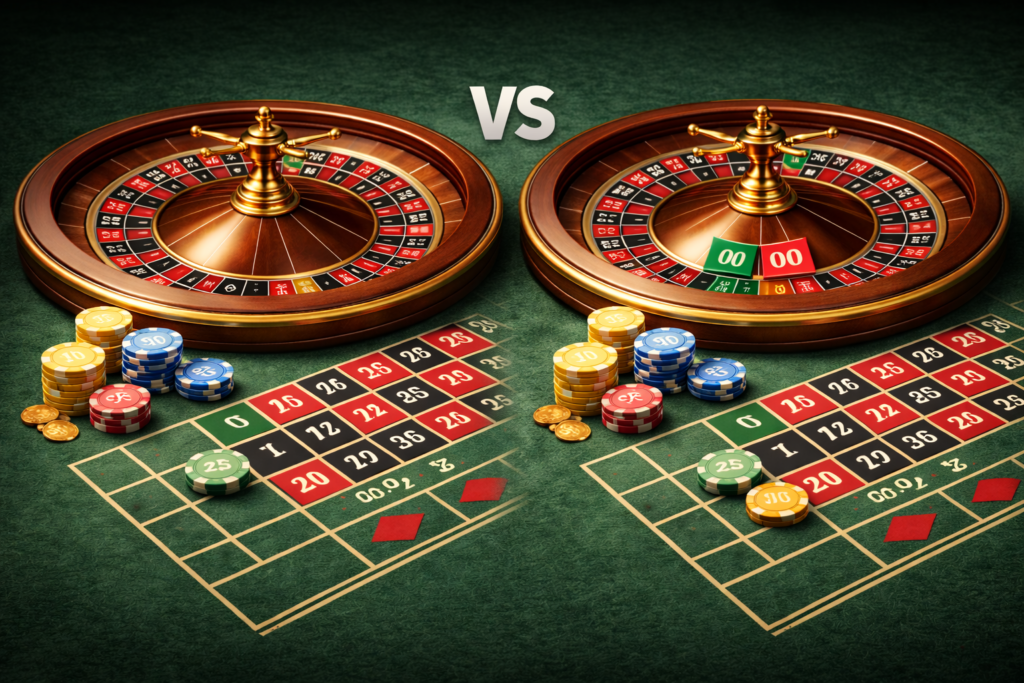
This comparison isn’t even close: European roulette obliterates American roulette in player value, making it unequivocally the best bets for roulette regardless of betting strategy. The single zero advantage dramatically impacts both house edge and long-term results.
European Roulette Odds
European wheels feature 37 pockets (0-36), creating a 2.7% roulette house edge percentage on standard bets. On even-money bets, European wheels give you 18/37 (48.65%) winning chances. The roulette probability chart shows straight-up bets pay 35:1 with 1/37 (2.70%) hit rates. Some European casinos offer “en prison” or “la partage” rules on even money wagers. If the ball lands on zero, these rules either imprison your bet for the next spin or return half your stake immediately. Both reduce the house edge on even-money wagers to approximately 1.35% — the absolute best odds for roulette available in standard games.
American Roulette Double Zero
American wheels add a double-zero pocket (38 total), pushing the house edge to 5.26%—nearly double European wheels. American wheels drop even-money winning chances to 18/38 (47.37%). Straight-up bets pay 35:1 but offer only 1/38 (2.63%) hit rates — you’re less likely to hit yet paid identically. Over 1,000 spins betting $10 per spin, American roulette costs $526 in expected losses versus European roulette’s $270.
Do Betting Systems Change the Best Bet?
Betting systems like Martingale, Fibonacci, D’Alembert, and Labouchere enjoy popularity among roulette players convinced they’ve discovered a simple roulette strategy that works to beat the house. The mathematical reality disappoints: no betting system alters fundamental roulette odds or house edge. They redistribute volatility and change short-term outcome distributions but cannot overcome negative expected value in roulette inherent to the game.
The casino edge comparison reveals that house advantage applies per spin independently. Whether you bet $10 flat or employ a progressive system wagering $10, then $20, then $40 after losses, the expected value remains negative at the same percentage rate. Betting systems manipulate stake sizes, not probabilities. A $10 bet on red carries 2.7% house edge, and a $640 bet on red after six losses still carries 2.7% house edge — you’re simply risking more money at the same disadvantageous roulette odds.
If employing a system, understand you’re choosing a variance preference, not improving odds playing roulette. Systems cannot transform roulette into a positive expectation game. The statistical bet in roulette with the best expected value remains the same: European wheel even-money wagers at 2.7% house edge.
What Is the Best Bet for Different Types of Players?
Optimal roulette bet combinations and strategies vary based on player objectives, risk tolerance, and bankroll size.
Conservative Players: Even-money outside bets (red/black, odd/even, high/low) on European wheels provide the highest chance of winning roulette with minimal volatility. These low risk casino bets sustain bankrolls longest and deliver predictable results.
Moderate Risk Players: Dozen or column bets offering 2:1 payouts hit approximately one-third of spins, creating a middle ground between even-money frequency and higher-payout inside bets.
Aggressive Players: Straight-up bets and small combinations accept low hit rates for substantial payouts. These represent high volatility gambling options where rapid bankroll depletion is likely. The roulette snake bet—covering 1, 5, 9, 12, 14, 16, 19, 23, 27, 30, 32, 34—offers an exotic alternative.
Regardless of risk profile, always choose European over American roulette.
Conclusion
So what is the best bet in roulette? From a pure mathematics standpoint, even-money wagers on European roulette wheels — particularly those with en prison or la partage rules — offer the statistically optimal combination of highest chance of winning roulette, lowest roulette house edge percentage, and most predictable variance.
However, “best” remains subjective. Inside bets sacrifice win frequency for higher payouts, appealing to players seeking excitement over consistency. The true best bets for roulette align with your goals: extended play favors outside bets, while big win chases justify inside bets despite worse hit rates. Crucially, always choose European wheels over American when possible — the single zero advantage provides indisputable mathematical superiority.
FAQ
Can the best roulette bet change during a game session?
No, the mathematical properties of each bet remain constant throughout any session. The roulette house edge percentage, probability, and expected value don’t change based on previous results — each spin is independent.
Are live dealer roulette tables different in terms of betting value?
Live dealer games use the same wheel layout structure and roulette probability chart as standard tables, so betting value remains identical. The single zero advantage of European wheels versus American roulette double zero impact applies equally.
Do high table limits affect which bet is considered optimal?
Table limits don’t alter fundamental roulette odds or house edge, but they constrain betting system strategies. The mathematically optimal bet remains the same — limits just determine whether your bankroll can sustain that strategy.
Is roulette more favorable in online casinos or land-based casinos?
Neither environment changes core roulette odds — the wheel layout structure and roulette house edge percentage are identical whether playing roulette online or at physical tables. However, online casinos often offer lower minimums, European wheels more readily, and sometimes favorable en prison/la partage rules on even-money wagers.
Can you combine multiple bets to reduce overall risk?
Combining bets doesn’t reduce house edge — it simply spreads exposure. The statistical bet in roulette with best value remains single, well-chosen wagers rather than complex combinations.